


Tax season is not the only time to pay your taxes. If you’re buying or selling a home, property tax is a year-round affair where you will have to pay a stipulated amount to the government or local or state authorities.
Property taxes are every homeowner’s responsibility, and it certainly helps new homebuyers know what taxes they have to pay to buy and own a property. Even if you purchase a home for investment purposes and rent it out, you still need to pay a tax on your rental income.
The cost of owning a home doesn’t stop at the downpayment, monthly mortgage and utilities, and home insurance. Property tax is just as important, so consider their rates and payment deadlines to avoid a late fine.

What Are The Types Of Property Taxes In Malaysia?
There are five types of property taxes every homeowner should know of:
1. Property Assessment Rate (Cukai Taksiran / Cukai Pintu)
This property tax is imposed by the local council (Majlis Perbandaran) and comes on a blue piece of paper.
The cost is based on the estimated gross annual rental value of the property and multiplied by a set of rates determined by the respective local council.
Besides that, the rates depend on the type of property. Commercial properties incur a higher rate than residential properties, where generally, residential property owners pay a rate of 4% of the estimated annual rental value, and commercial property owners pay a rate of 10%.
Cukai taksiran is paid in two instalments annually: from 1 January to 28 February for the first half of the year, and from 1 July to 31 August for the second half (in most states). Any tax paid after the last date of payment will be charged 1% per month or partially.
Here’s a simple way on how to calculate cukai taksiran:
Residential property’s monthly rental value: RM1,500
Residential property’s annual rental value: RM18,000 (RM1,500 × 12 months)
Property tax rate: 4%
Overall annual cukai taksiran to pay: RM720 (RM18,000 × 4%)
Because it is calculated as an annual figure but paid twice a year, the RM720 will be split into two payments of RM360 due every six months.
Not everyone’s cukai taksiran is the same, as factors like building type, built-up, location, and even construction materials contribute to a difference in rates.
The tax applies to all residential and commercial properties. But if you have a vacant property or land not in use, you can apply with your local council for a rebate on your property assessment rate.
Revenue collected from this tax is used to maintain and construct public infrastructure around the property, like the roadworks, drain works, trimming trees, cutting grass, traffic lights, and the bulbs for street lamps.
2. Quit Rent (Cukai Tanah)
Landed property on freehold or leasehold lands must pay quit rent, or cukai tanah, to the state’s Land Office, typically before 31 May every year.
The bill for your quit rent is a bright yellow paper, so you definitely won’t miss it.
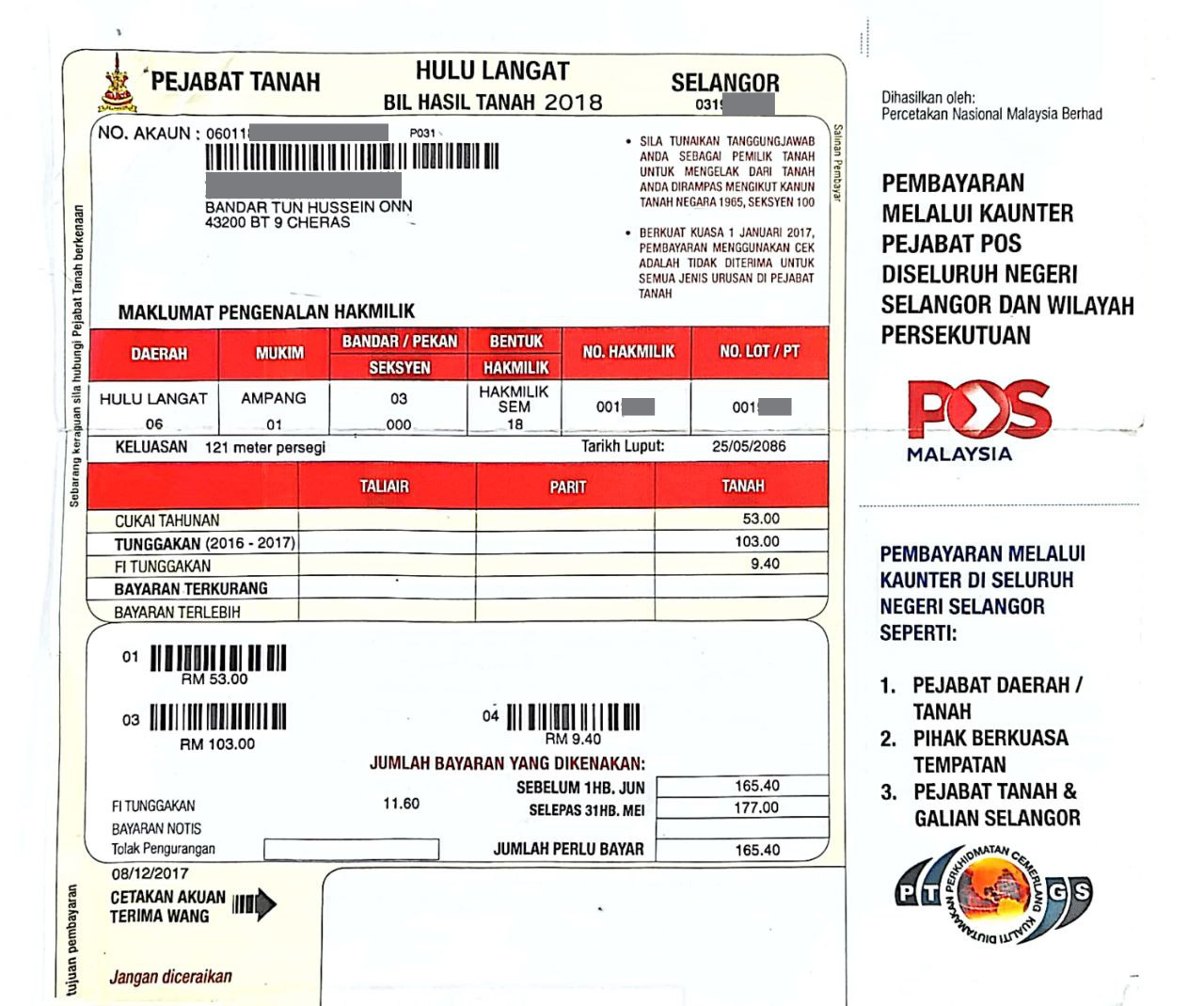
Effective 2024 for certain states, physical cukai tanah bills will no longer be issued, and homeowners can check their rates and payments online.
Quit rent rate differs based on state and can change every year. Nonetheless, it is determined by multiplying the property’s square foot by a specific rental rate.
How to calculate cukai tanah:
Specific rental rate: RM0.38 psf
Property size: 700 sq ft
Overall cukai tanah to pay: RM266 (RM0.38 psf × 700)
Previously, quit rent was also charged to strata properties, where it was paid to the development’s Joint Management Body (JMB) or the Management Corporation (MC), who submitted it to the Land Office.
In 2018, the Selangor state government changed the system and introduced parcel rent to replace quit rent for strata properties. Penang and Kuala Lumpur followed in 2019 and 2020 respectively.
3. Parcel Rent (Cukai Petak)
If you live in a strata-titled property, like an apartment, you will pay parcel rent instead of quit rent – regardless of residential or commercial land. However, parcel rent has higher costs than quit rent because it is based on the whole size of the property.
How to calculate cukai petak:
Size of the property: 13,000 sq ft
Quit rent rate: RM0.035 psf
Overall cukai petak to pay: RM455
Before parcel rent was introduced, the overall tax would be divided based on the number of units in the building. Hence, if there are 20 units and based on the example above, each unit owner would only pay about RM22 (RM455 ÷ 20).
With the new parcel tax system, it is undeniably more expensive than quit rent. But not without any reasoning, as the Land Office will now be able to monitor defaulters individually and closely.
4. Rental Income Tax
When you file your yearly income tax, you’ll notice a section that states “Statutory income from rents”. Leasing your residential and commercial properties, plus machinery and ships, will fall under this category.
This tax rate is anywhere between 0% to 30%, depending on your rental income’s progressive rate.
To get an accurate figure for your net taxable rental income, you can deduct expenses related to the care of the property, such as the maintenance fee (for strata properties only), property assessment tax, quit rent, and property repairs.

How to calculate rental income tax:
Monthly rental income: RM1,000
Yearly rental income: RM12,000 (RM1,000 × 12)
Total deductible expenses: RM10,000
Total rental income tax to pay: RM2,000 (RM12,000 – RM10,000)
What if your property has been empty and income-less for the past year? You don’t need to declare its rental income (because there is none), but you can file its upkeep expenses. This deductible expense will help offset your total taxable rental income if you have other properties.
Plus, if your total rental income tax to pay is negative or comes up at a loss, you do not need to declare it as rental income when filing your income tax.
5. Tax On Property Transactions
This can be separated between two different transactions: the tax for purchasing a property and the tax incurred when selling a property.

Tax for buying property:
This tax involves stamp duty imposed on the Sale and Purchase Agreement (SPA), Instrument of Transfer documents, and other loan documents.
The stamp duty for the SPA costs RM10 per copy. Instrument of Transfer documents, such as the Memorandum of Transfer (MOT) or Deed of Assignment (DOA), are based on the price of the property and range from 1% – 4%.
- First RM100,000: 1% stamp duty
- From RM100,001 to RM500,000: 2% stamp duty
- From RM500,001 to RM1 million: 3% stamp duty
- RM1 million and above: 4% stamp duty
How to calculate stamp duty based on a property price of RM600,000:
1% stamp duty on the first RM100,000: RM1,000
2% stamp duty on the next RM500,000: RM10,000
Total stamp duty to be paid: RM11,000 (RM1,000 + RM10,000)
Stamp duty also applies to your loan agreement, which is a flat rate of 0.5% of the loan’s full amount.
Total property price: RM600,000
Total loan amount: RM540,000 (90% of the property price)
Stamp duty for loan agreement: 0.5%
Total stamp duty to be paid: RM2,700 (RM540,000 × 0.5%)
Tax for selling property:
In terms of selling property, the tax imposed is called the Real Property Gains Tax (RPGT).
RPGT is only imposed if the property is sold within a certain number of years, and only if a profit is made. However, Malaysians are entitled to an RPGT tax exemption once in a lifetime, but only for private residences.
RPGT rates also differ if you are a Malaysian citizen, permanent resident, foreigner, non-citizen, or if the property is owned by a company.
An example of RPGT rates for Malaysians and permanent residents are:
| Ownership Period | RPGT Rate |
| 0-3 years | 30% |
| 3-4 years | 20% |
| 4-5 years | 15% |
| More than 5 years | 0% |
Your total RPGT can be evaluated by multiplying your chargeable gain with the specific RPGT rate.
How to calculate RPGT:
Original property price, bought 2 years ago by a Malaysian: RM600,000
Selling property price: RM750,000
Chargeable gain: RM150,000 (RM750,000 – RM600,000)
Total RPGT to pay: RM45,000 (RM150,000 × 30%)
Similar to rental income tax, you can also offset your RPGT with allowable deductible expenses that go into the upkeep of the property. Just make sure you file your RPGT within 60 days of selling the property so you won’t receive a late fine!

Take Note Of Property Taxes
Property tax doesn’t have to be complicated and taxing – all you need to do is keep track of when to pay it, how much to pay, and where to pay it. At times, there may even be exclusive rebates or exemptions that can help you save money.
The complete opposite is spending it and more, which can happen if you fail to pay your property assessment rate, quit rent, or RPGT on time. Under-declaring your rental income or misreporting it can also result in late penalties. Honesty is the best policy, so practice it to avoid negative repercussions.
Related Topics: